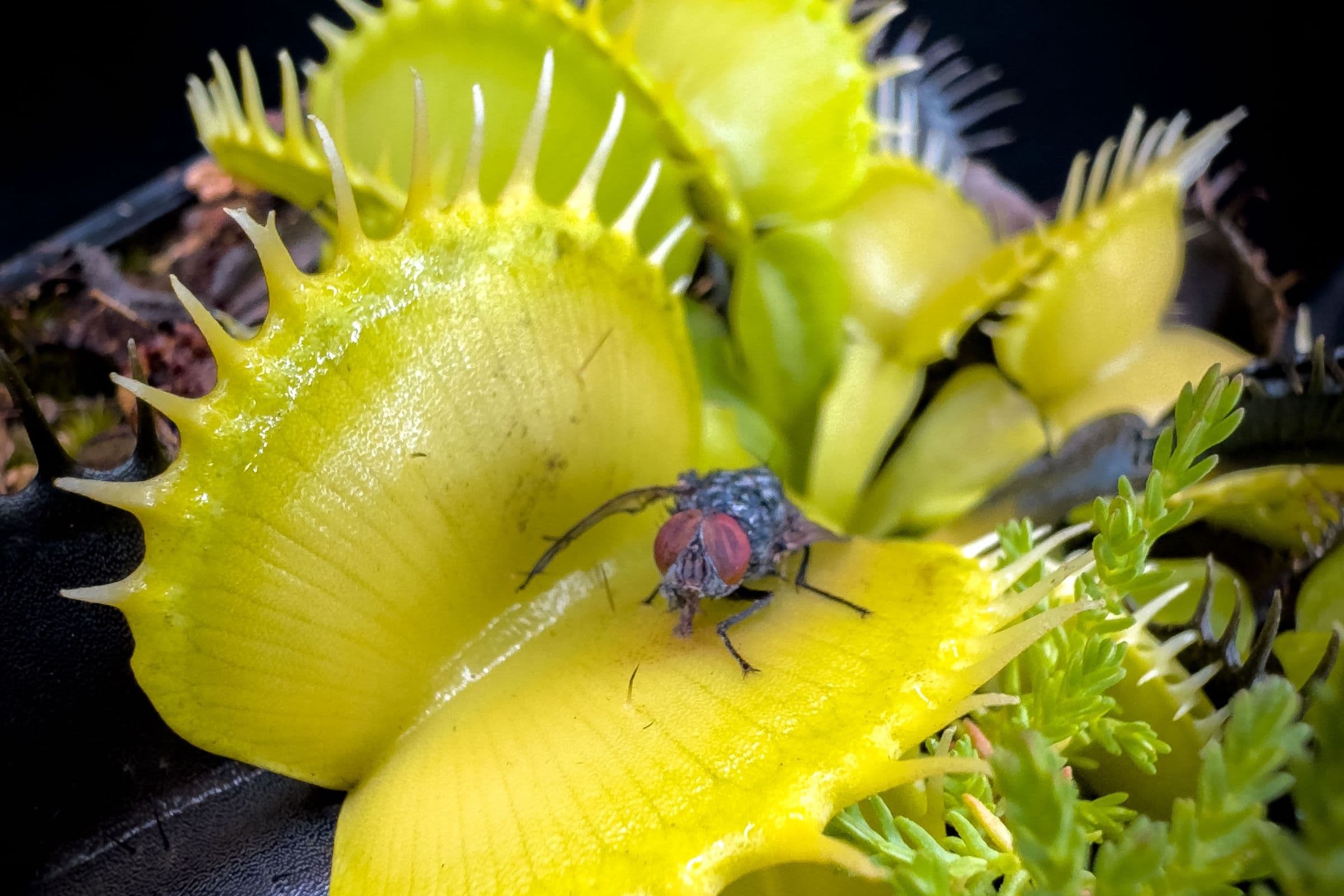
Venus flytraps are probably the most misunderstood carnivorous plants when it comes to feeding. Because they “eat meat,” many beginners assume they can be treated like tiny animals when given pieces of food, snacks, or anything rich in protein.
That’s where things start going wrong.
In reality, Dionaea Muscipula is highly specialized and its feeding mechanism is built for one thing only: catching and digesting small insects.
What Venus Flytraps Actually Eat
In their natural habitat, Venus flytraps grow in nutrient-poor bogs where the soil provides almost no usable nutrients. To compensate, they evolved traps that capture prey such as flies, ants, spiders, or small beetles.
But it’s not just about what they catch. It’s also about how they catch it.
When an insect touches the sensitive trigger hairs inside the trap, it causes the trap to close. If the prey continues to move, the plant receives confirmation that it’s dealing with something alive. Only then does it seal the trap completely and begin digestion.
This detail is important, because without movement, the plant may not activate the full digestive process.
Can You Feed a Venus Flytrap Yourself?
You can but in most cases, you don’t need to.
If your plant is kept outdoors or in a place where insects are present, it will feed naturally without any help. Feeding becomes relevant mainly for indoor growers who want to support the plant’s growth.
Even then, it should be done carefully.
Small insects are ideal and the size matters more than people expect. If the prey is too large, the trap may not seal properly, which can lead to rotting instead of digestion. As a general rule, the prey should not exceed about one third of the trap’s size.
Why You Should Never Experiment with Human Food
One of the most common mistakes is trying to feed Venus flytraps with human food such as small pieces of meat, ham, cheese, or other protein-rich items.
It might seem logical, but it goes completely against how the plant functions.
Unlike animals, Venus flytraps are not equipped to process fats, complex proteins, or processed food. When you place something like meat inside a trap, it doesn’t get properly digested. Instead, it begins to decompose.
This often leads to mold, bacterial growth and eventually the death of the trap itself. In some cases, repeated mistakes like this can weaken the entire plant.
The trap turning black after feeding is often not a sign of successful digestion. It’s a sign that something went wrong.
Some growers also use dead or dried insects, but in those cases, the trap needs to be gently stimulated to mimic movement. Otherwise, the plant may simply reopen the trap without digesting anything.
How Often Should You Feed?
Another common misconception is that more feeding equals faster growth.
In reality, Venus flytraps are relatively slow and efficient. Each trap can only digest a limited number of meals before it dies off naturally. Overfeeding simply wastes the plant’s energy and can lead to stress.
Feeding one trap every week or two is more than enough and even that is optional.
The Bigger Picture
Feeding is often seen as the most exciting part of growing Venus flytraps, but it’s actually one of the least important factors for long-term success.
Light, water quality and seasonal dormancy matter far more.
A healthy plant placed in proper conditions will take care of feeding on its own. Trying to “improve” this process usually does more harm than good.
Final Thought
When it comes to feeding Venus flytraps, the best approach is simple: follow nature, not assumptions.
Stick to insects, keep things minimal and avoid unnecessary experiments. Because with these plants, less intervention almost always leads to better results.
Take care! 🌱
— Peter