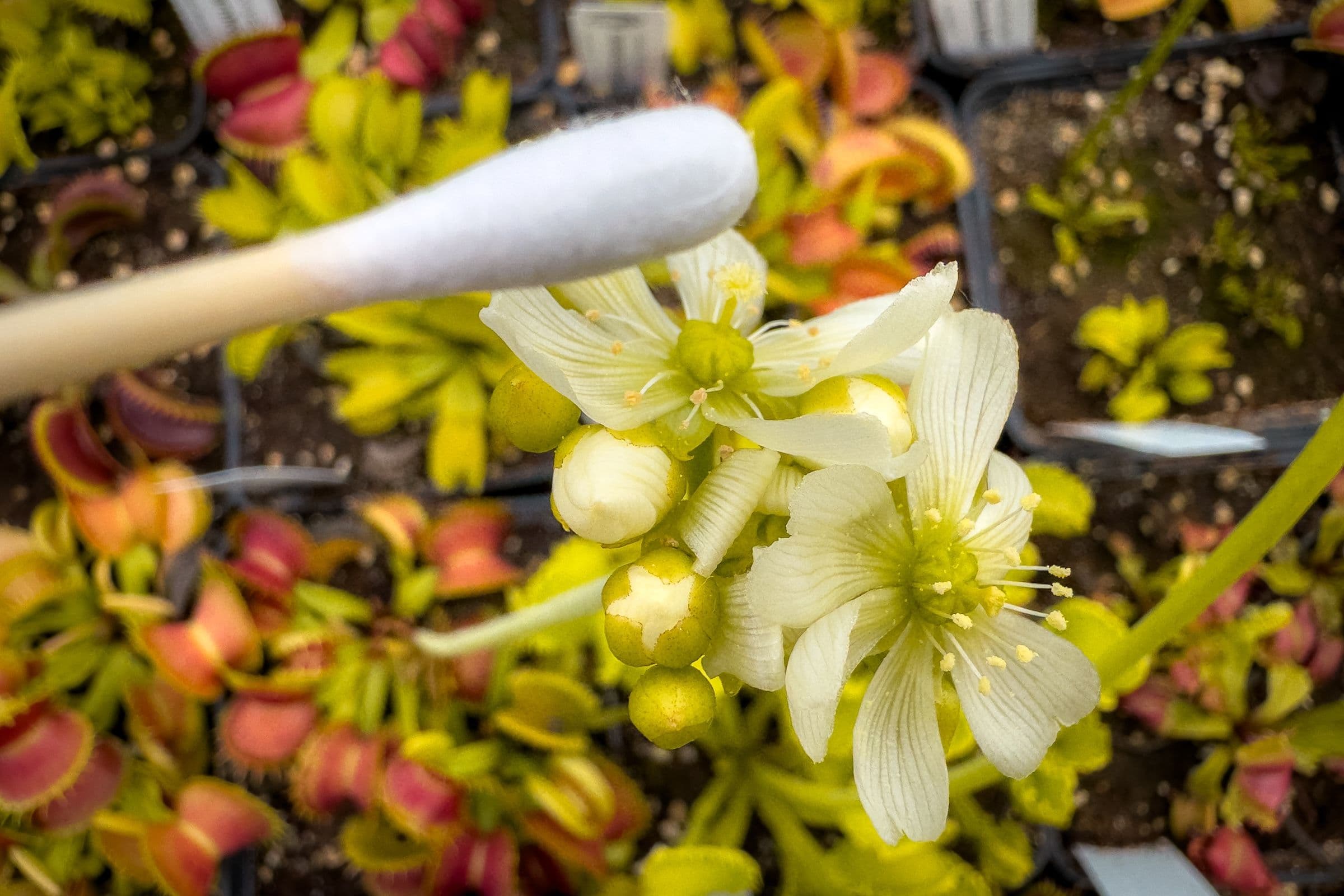
Once my Dionaea cultivars begin flowering, everything suddenly becomes much more intense. One day the flower stalks are closed and the next morning the greenhouse is full of fresh white flowers ready for pollination.
And the tricky part? You really need to check them constantly.
I usually inspect the greenhouse several times a day because every time I walk inside, another flower seems to have opened. Fresh pollen doesn’t wait forever and timing plays a huge role if you want successful cross breeding.
With a larger collection, it quickly turns into controlled chaos.
When Venus Flytraps Usually Flower
Most Venus flytraps start flowering during spring, usually from April to June depending on growing conditions and climate. In my greenhouse, the first flower stalks often begin appearing in early spring as the plants wake up from dormancy. Some cultivars bloom earlier, others much later, which means pollination season can last for several weeks.
A Venus flytrap is ready for pollination about 24 hours after a flower opens. At this point, the pollen-shedding anthers are ready and the central stigma will transform from a single point into a fuzzy, star-like or "pom-pom" brush ready to receive pollen.
My Favorite Tool: Cotton Swabs
A lot of people use brushes for pollination, but honestly? I prefer simple cotton swabs.
The pollen sticks to them surprisingly well and they make it easy to transfer pollen directly onto the stigma of another flower without making a huge mess. Venus flytrap pollen is incredibly tiny, almost dust-like, so precision matters more than people think.
One very important thing I learned over time:
I always use a fresh cotton swab for every single cross.
Why? Because microscopic pollen grains stay attached to the cotton very easily. Reusing the same swab can completely ruin targeted pollination and accidentally mix genetics you wanted to keep separate.
When you’re trying to create specific crosses, details matter.
The Greenhouse Smells Like Vanilla
This might sound weird… but every flowering season I notice the same thing.
The flowers smell like vanilla.
I’m not joking. Every time I walk near blooming Dionaea flowers, there’s this soft sweet scent in the air that genuinely reminds me of vanilla pudding or vanilla sugar. Maybe my brain is broken after spending too much time in the greenhouse, but I swear it’s there.
Now I smell the flowers every single season just to confirm I’m not imagining it.
Still vanilla.
Labels, Notes, and Controlled Chaos
Right after pollination, I immediately write everything down.
Which plant was the pollen parent.
Which flower received the pollen.
Which cultivars were crossed together.
Then I label the flower stalk so I can recognize it later once the seed pods begin developing. Trust me, after dozens of flowers open at the same time, it becomes impossible to remember everything without notes.
A single missed label can turn a dream cross into a complete mystery.
Open Pollination: Letting Nature Decide
Not every flower in my greenhouse gets controlled pollination.
I also let many of my typical Venus flytraps flower naturally. With these, I simply use my hands and gently mix pollen between flowers, letting nature take over the rest.
Honestly, some of the most exciting plants can come from these random open-pollinated seedlings. You never fully know what traits might appear later. Stronger colors, strange teeth, unusual growth patterns, or completely unexpected combinations.
That unpredictability is part of the magic.
Waiting for the Next Generation
After the flowering season ends, the waiting begins.
Timing is everything during pollination season. Some flowers release pollen before others are ready to receive it, so checking the greenhouse multiple times per day becomes almost necessary when working with targeted crosses.
If pollination was successful, the flowers slowly produce seed pods full of shiny black seeds. And honestly, that feeling never gets old. Every seed carries the potential for something unique.
Later, when the seedlings finally start growing, you begin spotting tiny differences between them. Some grow faster. Some show color early. Some suddenly develop strange traps that make you stop and stare.
With a large collection, the whole process is exhausting, messy and sometimes overwhelming.
But at the same time, it’s one of the most magical parts of growing Venus flytraps. Watching an entirely new generation appear from crosses you made yourself and wondering if the next extraordinary plant is hiding somewhere among them. Love it!
— Peter 🌱